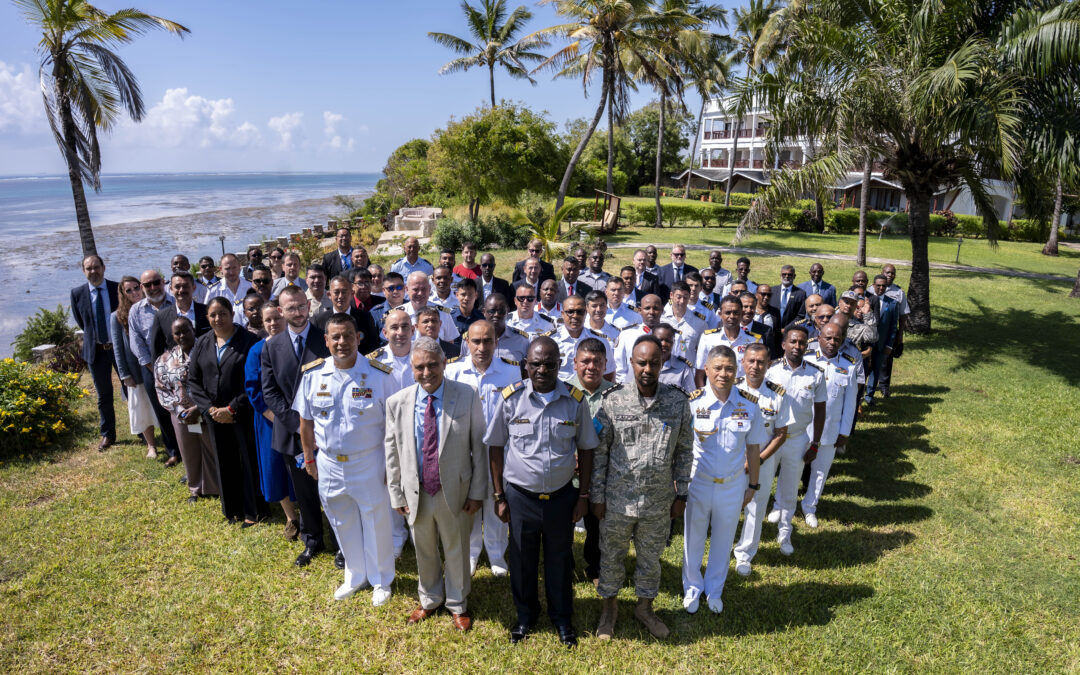
Over three days, more than 60 officials representing over 30 countries met in Mombasa, Kenya, for the 4th IORIS Steering Committee Policy Board and Working Groups Meeting. The meeting was co-hosted by the Kenya Coast Guard Service (KCGS) and the European Union, and organised by the EUCRIMARIO project. Their shared objective was to make the sea safer and more secure through closer cooperation between maritime organisations and entities, across borders and across sectors. That cooperation is facilitated through IORIS, the coordination and information-sharing platform that EUCRIMARIO has developed and implemented since 2018.
Mr Bruno I. Shioso, EBS, OGW, Director General of the Kenya Coast Guard Service, welcomed participants: “The waters off our coast connect us to the whole Indian Ocean, and so do the challenges we face there. Information shared in time can save lives and stop crime. By strengthening how we cooperate with our regional and international partners with the support of IORIS, we are building a safer and more secure maritime environment for our seafarers, our fishing communities and our economy.”
Antoine Hanin, Programme Manager, Security Governance and Maritime Security, at the European Commission, which co-hosted the event, affirmed: “The security of the sea is the foundation of trade, livelihoods and stability for all of us. Kenya and the European Union share a strong commitment to a peaceful and rules-based maritime order, and today’s meeting shows what that commitment looks like in practice: agencies from many countries choosing to work side by side. The European Union will continue to stand with its partners in this effort.”
Recognising that threats at sea transcend national jurisdictions, participants focused on how agencies can work together more effectively: nationally between authorities, and internationally between neighbouring countries and regions. Partner agencies presented IORIS success stories showing how the platform supports real operations. The results of the ISC 2026 survey will help shape priorities for the year ahead.
“IORIS is only as strong as the cooperation behind it,” said Martin Cauchi Inglott, EUCRIMARIO Director. “Over the years, IORIS has grown from a technical tool into a genuine community of maritime organisations and entities that trust one another. This meeting is where that community decides together how to work better: with shared procedures, solutions tailored to each sector and a clear legal framework. Cooperation is what makes the sea safer, and IORIS is the space where it happens.”
A central item on the agenda was the Regional IORIS Standard Operating Procedures (SOP) Version 2.0. Working by region, participants explored how to harmonise the way they collaborate through the platform. The aim is for alerts, requests for assistance and information exchanges to follow common, predictable steps across agencies and countries.
Officials also discussed how the platform is evolving. Topics included the launch of the IORIS Mobile Phone Application and the MARCOM App, IORIS security, and feedback from the regional hubs. Sectoral discussions on developing IORIS variants addressed the specific needs of port and ship security, Search and Rescue (SAR), and the fight against illegal, unreported and unregulated (IUU) fishing. The Operational Working Group reviewed how IORIS is used in real operations and examined operational enhancements proposed by partners. The Policy Board considered the steps needed to set up IORIS operational capability within each authority.
Meanwhile, the Legal Working Group addressed memoranda of understanding, data protection and the handling of digital evidence, so that cooperation through IORIS rests on a sound and trusted legal basis.
The meeting closed on 12 November with conclusions from the Working Group Chairs and concluding remarks by EUCRIMARIO and the Kenya Coast Guard Service.
Recent Comments